Three ways to get over a bar and back down again. Most beginners never really pick one — they inherit whatever their coach teaches or whatever the landing pit allows, and then spend a season unlearning bad habits. The style you learn first shapes how fast you improve, how you land, and whether going up to the bar ever feels routine. Here is a straight comparison, from the simplest technique to the one with the highest ceiling.
Look at the Landing Area Before You Choose
Before debating technique, check where you will come down. The scissors and most straddle jumps let you land on your feet or roll onto your side. The flop puts you on your back, so it needs a deep, properly filled foam landing pit with room behind it. Practising flop clearances onto a thin mat, sand, or grass is how people get hurt, usually on the neck or lower back.
Whatever style you try, warm up thoroughly, keep the bar low for the first few sessions, and have someone experienced watch your takeoff rather than guessing. Anyone with a back, neck, or shoulder problem should speak to a doctor before starting high jump training, and a coach is worth having for anything beyond basic scissors work.
The Scissors: The Best First Jump for Most Beginners
You approach fairly straight or at a slight angle, take off from the foot on the far side of your body, swing the other leg up and over the bar, then bring the takeoff leg over to "scissor" past it. You sit upright through the jump and land on your feet, which is exactly why it is the safest place to start.
There is no back arch to learn and no backward landing to get used to. The timing is forgiving, and you can practise the action with an elastic bungee or a rope instead of a bar, which removes the fear of clipping it. The trade-off is height: with your body upright, your hips cannot be driven far above the bar, and most scissors jumpers plateau somewhere in the middle of the school range.
A quick scissors checklist
- Run straight at the bar at first, then add a slight angle as you get comfortable.
- Stay tall through the last two steps and keep the rhythm quick.
- Swing the lead leg up and over, keeping it fairly straight.
- Bring the takeoff leg over to complete the scissor.
- Land on the takeoff foot, then step away from the pit.
The Straddle: Reliable, Demanding, Often Overlooked
The straddle takes you over the bar face down. You take off from the outside foot, swing the lead leg across, then roll your chest toward the pit so your trailing leg follows. Depending on the pit and your speed, you land on your side, your back, or your feet.
It has real advantages. It works with less landing depth than the flop requires, and it suits jumpers who dislike travelling backwards through the air. Multi-event athletes often keep a straddle in their back pocket because it is serviceable without much practice.
The cost is technical. It asks for hip mobility, a strong back arch, and precise timing, and it loads the lower back more than the other two styles. Beginners usually need a coach's eye to make it work, and without one, progress stalls quickly.
The Fosbury Flop: Fast, Fun, and Built on Basics
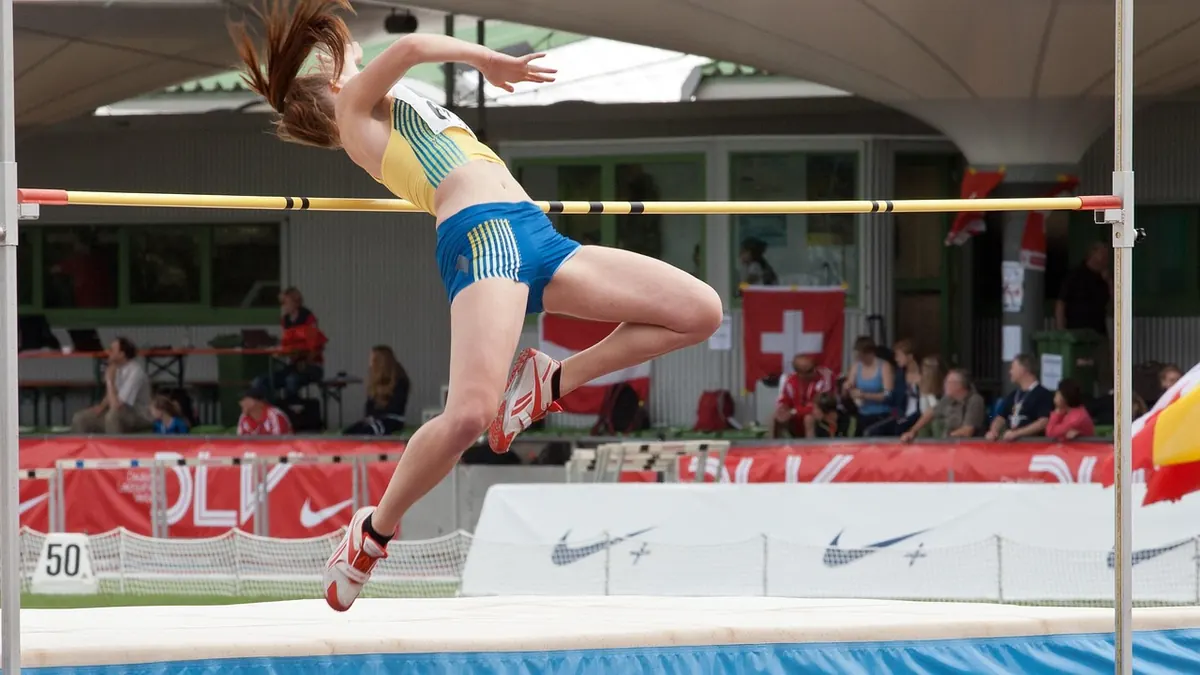
Back first over the bar. You run a curved approach — usually called a J-curve — take off from the outside foot, arch so your hips rise above your head, then snap your legs up and land on your shoulders and upper back in a proper pit. It has the highest ceiling by a wide margin, because the curve turns your running speed into rotation instead of fighting it.
It also has the steepest entry price. You need a real pit, a coach or experienced training partner, and the willingness to land backwards repeatedly while you learn. The most common beginner error is running straight at the bar and only curving at the last moment, which kills the rotation you need. Practise the curve on its own, then land back-first from a low bar, and only then build up your approach.
Nobody clears a bar with a style. They clear it with a good approach and a confident takeoff — the technique just decides what happens next.
Which Style Fits Which Beginner?
There is no single right answer, but there are sensible defaults:
- Younger children and complete first-timers: scissors, every time. It teaches takeoff timing and bar awareness without a risky landing.
- Teenagers with a proper pit and regular coaching: two to four weeks of scissors, then move to the flop.
- Multi-event athletes who jump occasionally: scissors as the default, flop basics if they train it weekly.
- Jumpers nervous about landing backwards: stay with scissors until back-first landings feel boring, then switch.
- Anyone without a safe landing area: keep the bar low and land on your feet, or find a proper pit before going higher.
Drills and Progressions to Test Each Style
- Start with a bungee or elastic bar. It removes the sting of contact and lets you commit to the takeoff.
- Walk your approach backwards from the takeoff point and mark your start with a cone or a shoe. Repeat until it is identical every time.
- For the flop, walk the J-curve slowly, then jog it, then run it — without the bar. The curve is a skill on its own.
- Practise back-first landings from a standing position next to the pit before adding any run-up.
- Film one jump from the side each week. Most beginners are surprised by how early they sit up or how straight their approach is.
- Raise the bar in small steps, roughly three to five centimetres at a time, and only after three clean clearances at the current height.
A Simple Way Forward
Spend your first few weeks on scissors while you build speed, rhythm, and confidence at the bar. If you have access to a proper pit and someone to watch you, add flop work twice a week: curved approach, back landings, low bar. Pick one technique per session — flipping between styles in the same practice muddles the movement pattern you are trying to build.
Keep a note of your start mark and the heights you clear, and review it every couple of weeks. Progress in high jump comes from a repeatable approach far more than from a dramatic change in style. If your back, knee, or ankle complains, stop and get it looked at before it becomes a season-long problem.
Photo: domeckopol / Pixabay